
Volcanic Context

Lacryma Christi in the Vesuvian Volcanic System
The Vesuvian volcanic system is characterised by a compact and relatively homogeneous geological structure, formed by major eruptive events that deposited extensive layers of pyroclastic materials. This configuration has produced continuous soils, with good mineral availability, thermal retention capacity and overall limited spatial variability.
Within this context, Lacryma Christi developed as the direct expression of a unified volcanic environment. Pedological and microclimatic conditions favour regular vegetative development and relatively stable ripening dynamics, contributing to a territorial identity defined primarily by system coherence rather than by site fragmentation.
Lacryma Christi therefore represents a model of volcanic viticulture based on territorial continuity. Its expression is structurally linked to a single large volcanic body, within which the main agronomic and geological variables operate in a relatively uniform manner, generating a recognisable and consistent style over time.
Structural differences compared to Nerello Mascalese on Mount Etna
The Etna system presents a profoundly different geological configuration. Superimposed lava flows, strong altitudinal gradients and marked soil fragmentation generate high spatial differentiation and a strong influence of site-specific factors.
In this context, varieties such as Nerello Mascalese exhibit behaviour strongly conditioned by individual slope, elevation, lava flow age and soil structure. Micro-territorial variability becomes a central element of wine identity.
The comparison highlights how, despite a shared volcanic origin, system morphology determines different viticultural models. Where Etna amplifies fragmentation and micro-differentiation, Vesuvius favours continuity, stability and a reduced dependence on site-specific factors. This distinction allows Lacryma Christi to be read not as a simple volcanic variant, but as the expression of a different structural model of viticulture on volcanic soils.
Strategic and irreproducible value of the dual-domain structure
The ownership of lacrymachristi.com and nerellomascalese.com brings under a single ownership two names that directly identify the two principal poles of Italian volcanic viticulture: Vesuvius and Etna. These correspond to a historic denomination and a symbolic grape variety, both used as primary references by producers, trade operators, media and international markets.
The two domains constitute natural access points to territories that, due to institutional structure and production identity, normally remain separate. Their coexistence under a single ownership does not derive from agreements or collaborations, but from a proprietary fact that concentrates in one subject two references that elsewhere are necessarily distributed.
The Name Lacryma Christi
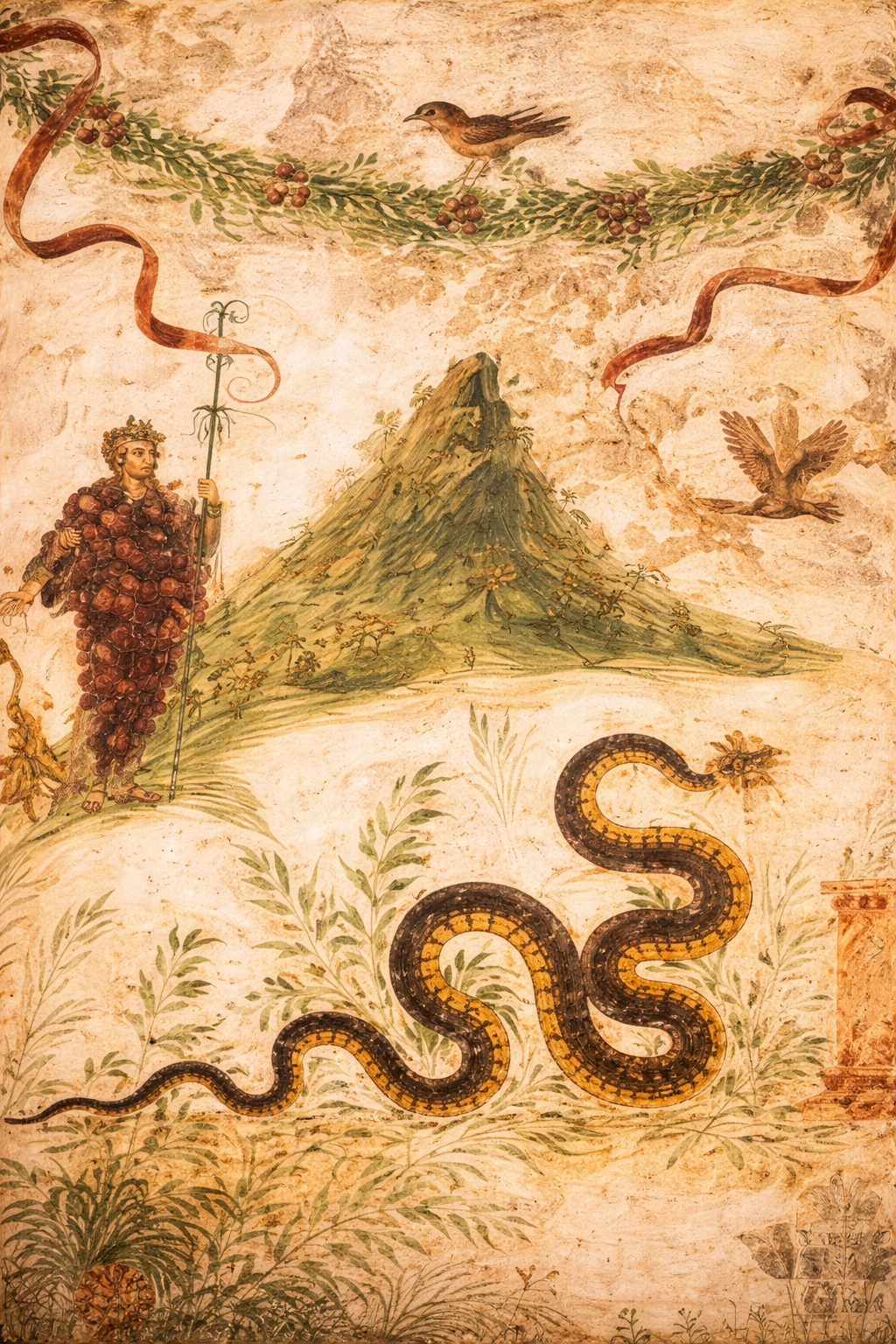
The name Lacryma Christi occupies a singular position within Italian wine culture because it originates at the intersection of myth, landscape and early written tradition. Unlike most Italian wine names, which derive from grape varieties, places or agrarian functions, Lacryma Christi is a symbolic designation whose persistence predates modern appellation systems.
The earliest attestations of the name appear between the late Middle Ages and the early modern period, when wines produced on the slopes of Mount Vesuvius were already distinguished from surrounding agricultural outputs. The designation draws on a Christian legend according to which Christ, contemplating the devastation caused by Lucifer’s fall upon the Gulf of Naples, shed tears that gave rise to the fertility of Vesuvian soils. While the narrative itself belongs to devotional tradition, its durability is significant: the name survived because it functioned as a mnemonic device anchoring wine, volcano and sacral geography into a single semantic unit.
Over time, Lacryma Christi ceased to operate as a metaphor alone and became a stable cultural reference for wines grown directly on volcanic terrain. By the seventeenth and eighteenth centuries, the term was already used in travel accounts and agrarian descriptions to identify wines from the Vesuvian slopes, indicating that the name had transitioned from legend to geographic shorthand. This evolution distinguishes Lacryma Christi from purely poetic wine names: it acquired descriptive power through continuity of use rather than through later branding.
The value of the name today lies precisely in this stratification. Lacryma Christi encapsulates a rare convergence of elements: an active volcanic system, a long-standing cultivation history and a denomination whose semantic charge has never been diluted into generic symbolism. The name remains inseparable from Mount Vesuvius, and unlike many historic wine terms, it has not migrated or been abstracted from its place of origin.
For this reason, LacrymaChristi.com represents more than a memorable domain. It corresponds to a finite and non-replicable cultural identifier, tied to a specific volcanic landscape and to one of the most recognisable symbolic narratives in Italian wine history.
Why Lacryma Christi Matters in Italian Volcanic Viticulture
Lacryma Christi is one of the very few Italian wine names whose identity predates modern appellations, regulations and branding. Its meaning is embedded in myth, geography and religious narrative tied directly to Mount Vesuvius.
Unlike many historic wine names later detached from place, Lacryma Christi remains inseparable from a specific volcanic system, making it a rare case of linguistic, geological and viticultural continuity.
Volcanic Origin
Historical Continuity
Place-Bound Identity
Digital Asset

“Owning both NerelloMascalese.com and LacrymaChristi.com allows for the preservation of two distinct but complementary volcanic wine identities.

Michele Romano
Designer, owner and originator of the digital domains, trademarks and intellectual structures constituting the core assets documented on this platform, and curator of its reference system.